Calls for crackdown on China chip exports – as it happened
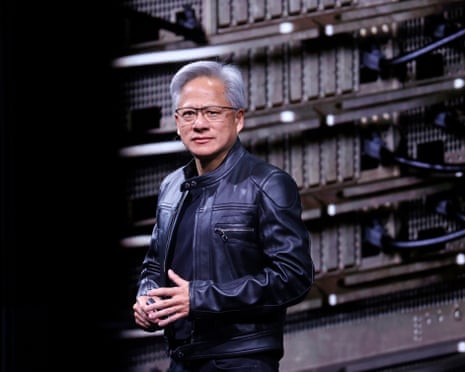


Growing calls for Congress to crackdown on chip exports to China US House Speaker Mike Johnson has said there is a growing consensus in Congress on limiting chip exports to China after the resignation of Nvidia CEO Jensen Huang. Huang stepped down after reports of a romantic relationship with a businesswoman whom US authorities suspect of spying for the Chinese government. The case has revived claims among China critics in Washington that US export policies are too weak, boosting calls for more restrictions. In the last week, representatives from both sides of the aisle have called for tougher restrictions on China’s access to advanced AI chips;
chips that could underpin China’s surging AI development. Nvidia’s advanced AI chips are widely used to develop cutting-edge AI models, making the company key to the US race against China to build superior AI systems. The US has sought for years to limit China’s access to Nvidia’s chips because it wants its own companies to stay ahead in the race. “The export controls on chips to China has been a big issue around here,” Johnson told reporters at the US Capitol, adding he favoured limiting China’s access to the advanced technology. “I think there’s a developing consensus in Congress that is an important position to take.“ Congressional Republicans are keen to attach new restrictions on exporting advanced AI chips to China in the annual defense authorisation bill, a must-pass measure that funds the military and typically attracts bipartisan support, according to a Senate aide, who spoke to Reuters on the condition of anonymity. Colette Kress – Nvidia’s interim CEO – was one of the few executives at the company willing to check Jensen Huang’s enormous, often risky ambitions, Reuters has reported, citing two sources familiar with the matter. Kress and her staff clashed with Huang and the company’s sales team over the massive financing deals that fed into what some Wall Street critics deemed a circular AI economy, including investments in OpenAI and AI infrastructure companies such as Lambda, according to one of the people familiar with the matter. A proposed $250bn plan to support an OpenAI data center project in Ohio was ultimately pared to $120bn. “I think it’s unlikely anyone but Jensen is going to invest in his own customers as aggressively,” said a third source, a venture capital investor. Kress served as an important counterweight to Huang, whose success afforded him great latitude on key decisions, the sources said. “Colette is a pragmatist,” a fourth source told Reuters. She can project calm and help stabilize markets while the search is ongoing, the person said, adding that Kress had been on recent calls to reassure customers and suppliers as the tumult inside the company unfolded. Under her leadership, Nvidia is likely to “approach DC more like other tech companies do, by trying to build capital and make friends,” instead of picking “a fight over export controls” the way it did under Huang’s leadership, the person said. Jensen Huang had enjoyed rock-star status in China, where his visits drew crowds seeking selfies and autographs, with his casual outings became social-media sensations. During a January 2026 visit, opportunistic sellers advertised photographs with the former Nvidia chief for 25,000 yuan, while a Beijing restaurant launched a special menu costing more than 400 yuan after he ate there. On Chinese social media, many expressed surprise at what they saw as the swift resignation of the former Nvidia CEO, and mourned the sudden end of his three decades at the top of the company. News of his resignation attracted more than 400m views overnight on Chinese microblogging platform Weibo. Meanwhile, Chinese AI companies are reportedly trying to secure Nvidia chip capacity outside China, amid growing concern that the gap in US export controls may now be closed after the scandal, people familiar with the matter told Reuters. Nvidia’s advanced chips have been at the centre of the US-China technology rivalry, with Washington restricting their exports to China over national security concerns. Beijing has also stepped up efforts to develop domestic alternatives, including through Huawei, although analysts say Chinese chips remain less efficient for training advanced AI models. Commerce secretary Howard Lutnick to testify before Congress US commerce secretary Howard Lutnick will testify before Congress on the Nvidia scandal. US lawmakers have called for clarity on what the Donald Trump’s administration knew about Nvidia chief Jensen Huang’s extramarital affair with a woman accused of spying for China. “Secretary Lutnick has proactively agreed to appear voluntarily before the Banking Committee to address their questions,” Kristen Eichamer, a spokesperson for Lutnick, told NBC News. Lutnick has come under scrutiny as the commerce department was mandated to review companies for national security risks before the Trump administration allowed Nvidia to sell advanced chips to China. Senate banking committee chair Tim Scott requested that Lutnick testify “for a public hearing regarding recent public reports about Nvidia and the Department of Commerce’s role that raises national security concerns”. Scott has also requested Jensen Huang testify before the committee. Malaysia’s government has said it is investigating a subsidiary of Megaspeed International over the possible diversion of advanced AI chips to other countries. On Thursday Nvidia boss Jensen Huang resigned over an affair, reportedly with Alice Huang – an alleged Chinese spy and former top executive at Megaspeed, a Singapore-based datacentre company. Megaspeed is under scrutiny for allegedly steering Nvidia AI chips to China despite US export rules designed to slow the development of Beijing’s artificial intelligence sector. Malaysia’s Ministry of Investment, Trade and Industry (MITI) said is it investigating whether a local subsidiary of Megaspeed reexported any chips brought into the country to other locations. MITI said it was also working “closely” with authorities in Singapore and the United States “and is considering further measures to strengthen controls where necessary”. Republican Senator Jim Banks has said that for the last two years, US lawmakers have been pushing to stop America’s “high-end computer chips from being exported to China.” Banks said he hoped that Jensen Huang would come and testify before Congress. Nvidia opposed my legislation a year ago. They opposed other export control laws. We have a lot of bipartisan questions and concerns about what’s happened over the last year that would allow some of these issues to continue to occur. A growing number of lawmakers criticised Lutnick for the administration’s refusal to add dozens of Chinese companies to a key US trade blacklist. In June, Reuters reported the Trump administration had held off from adding China’s AI startup DeepSeek, memory chipmaker CXMT and more than 100 other companies flagged as national security risks to the trade blacklist. The US has not posted any additions to that list since October 2025, the longest stretch between new postings in more than a decade. Reuters earlier reported that the US commerce department has not added new Chinese companies to that list for fear of escalating tensions between the US and China. “Secretary Howard Lutnick and Under Secretary Jeffrey Kessler must explain why they have not closed export control loopholes and act today to ensure our advanced technology is not fuelling China’s military,” Democratic Senator Elizabeth Warren said. Warren, who will chair the senate banking committee starting in January, wrote to Lutnick, secretary of state Marco Rubio and White House chief of staff Stephen Miller, telling the administration to preserve all documents related to Nvidia’s exports of advanced AI chips to China and related national security risks. Separately, US Senator Ron Wyden of Oregon and Representative Richard Neal of Massachusetts, the top Democrats on the Senate finance committee and House ways and means committee, wrote to Lutnick on Thursday, saying they were investigating the administration’s approval of sales of Nvidia’s advanced AI chips to Chinese companies “with concerning links to the Chinese government, military, and sanctioned entities.” The lawmakers also questioned Trump’s decision to grant Nvidia permission to sell its advanced H200 AI chips to China in December 2025 in exchange for a cut of the export sales through a Commerce Department action, which they called “an unconstitutional export tax.“ Jensen Huang supported more exports to China, despite repeated calls from China hawks in both parties to crack down on Beijing’s access to the technology. Why is US commerce secretary Howard Lutnick in the spotlight?
Republican Tim Scott – the chair of the US Senate banking committee – has called on Howard Lutnick to testify over the Nvidia scandal, as senior White House officials reportedly mull whether the commerce secretary should be pushed out of the Trump administration. As the fallout over the loss of one of the AI industry’s most significant figures continues, Lutnick has faced accusations he has not done enough to restrict chip shipments to China. The White House and commerce department did not immediately respond to requests for comment after Reuters reported White House officials were discussing Lutnick’s future. Earlier on Thursday, a White House official said Donald Trump “maintains complete confidence in the secretary and his ability to carry out the position”. The New York Times reported on Thursday that Lutnick has clashed with other Trump officials over how to regulate sales Nvidia’s chips – and that he has faced accusation from inside the administration that his department is “too cozy with Nvidia and its co-founder, Jensen Huang” and failed to “adequately police the firm’s chip sales to China”. A number of Republicans have gone public with their demand that Lutnick explain his agency’s apparent failure to block Megaspeed – the company linked to Alice Huang – from buying advanced chips. US officials had reportedly started to monitor Alice Huang after suspecting the firm she worked for was diverting powerful Nvidia AI chips to Chinese firms, in potential violation of export restrictions. “The obvious question is why did he choose to sell advanced chips?
,” Republican Senator John Kennedy said in an interview on Wednesday. Secretary Lutnick needs to answer that in front of God and country. If I were he, I’d call a press conference this afternoon and explain what happened and why he agreed to sell ‘em chips, and I would stop doing it.” As questions abound about Megaspeed, Singaporean authorities said in a statement on Thursday that Alice Huang, the Chinese woman at the centre of the global spy drama had been barred form re-entering the city state after a 2025 investigation into the company. The ministry of home affairs said it had held Alice Huang’s passport from June 2025 until February over “potential false declarations” related to Megaspeed, which is registered in the country. Eventually she was released with a stern warning, but she has been barred from re-entering the country. Huang was being investigated in Singapore as part of a larger probe into several companies, including Megaspeed. Singapore police said last October they were investigating Megaspeed over “suspected breaches of our domestic laws” after a US senator requested the commerce department investigate whether the firm had diverted Nvidia chips. In Taiwan, the interior minister told lawmakers on Wednesday that Alice Huang was also now barred from entering the territory. From a lottery retailer in rural Australia to a dilapidated storefront in Kuala Lumpur, and an unexpectedly quiet office in Singapore, as the Nvidia scandal has unfolded more information has emerged about the activities of cloud computing firm Megaspeed, and its former director Alice Huang. On its website, Megaspeed, which is registered in Singapore, describes itself as a Nvidia cloud partner in the Asia-Pacific region. In the past three years, Megaspeed has been one of Nvidia’s biggest foreign customers, purchasing nearly $5bn in AI chips and advanced hardware. But questions have been raised about the seeming incongruity between its corporate presence and business activities. Singaporean news outlets, The Straits Times reported that Swiftdata, which owns Megaspeed, has a registered business address that an interior design firm says it has occupied for over four years. When the New York Times visited Megaspeed’s Singapore headquarters last year, located in the central business district, only two employees were present. In Malaysia, one of Megaspeed’s offices was reportedly a dilapidated store front in Kuala Lumpur. Another was located in a shopping mall, the Times reported. When one employee emerged in the mall, she was asked what the company did. “It’s not clear,” she responded. Meanwhile in Australia, Reuters tracked corporate filings of Megaspeed affiliates that led it to a man in his twenties born in Shanghai. The individual is also registered as director of Megaspeed’s Malaysian, Indonesian and Thai units, according to Reuters. Unable to contact him, Reuters tracked his home address to a small newsagent and lottery retailer in a regional town outside Melbourne where they found a woman who said she was his mother. The woman said she had run the business for about 16 years, that her son was based in Shanghai and had nothing to do with the Singaporean company. Some US lawmakers are pushing for a swathe of new legislation that would affect the export of AI chips from America. The AI Overwatch Act would give Congress more power over advanced AI chip exports. The Chip Security Act would require companies to track the location of advanced AI processors to prevent smuggling. The Match Act would pressure US allies to restrict sales and maintenance of advanced chipmaking equipment destined for China. The Remote Access Security Act would give the Commerce Department the tools to stop Chinese firms from renting overseas data centers to access Nvidia chips. US representatives from both sides of the aisle have been questioning Donald Trump’s decision to grant Nvidia permission to sell its advanced H200 AI chips to China in December 2025 in exchange for a cut of the export sales. Trump’s close ties with billionaire Jensen Huang have also come under renewed scrutiny after revelations about the former Nvidia CEO’s affairs, including with a businesswoman alleged to be a spy for China. Over the past two years, Huang has voiced support for the Trump administration’s AI agenda and met the Republican leader many times, lobbying for looser restrictions on Chinese access to Nvidia’s sophisticated AI chips. Huang and the White House have argued that continuing US sales to China would keep Chinese customers reliant on US technology. Democratic and Republican lawmakers are now calling for a halt to exports of advanced AI chips to China. Stocks in Asia rose slightly on Friday after a turbulent week dominated by the revelations of Jensen Huang’s extramarital affairs that culminated in the Nvidia CEO’s resignation. His exit has plunged the chipmaker into crisis and sent shock waves through the AI industry. But a commonly used index of Asia-Pacific shares outside Japan was up 0.26% on Friday, reversing some of its 1.3% fall from the previous session. South Korea’s Kospi rose 2.35% while Japan’s Nikkei added 1.4%. Nvidia shares fell 3% in after-hours trading, while those of its customers, including South Korea’s Naver, extended declines on Friday, with Naver down 2.75%. “[Huang’s] departure leaves a vacuum that will be difficult to fill … We do not assume existing commitments change, but new deals could take longer or require more compensation as investors look for reassurance about Nvidia’s role,” analysts at JP Morgan said in a note. The bigger implications are for the rest of the AI trade, particularly GPU financing and infrastructure deals in which Nvidia would presumably be involved as a supplier, investor or provider of contractual support.” Jon Zauderer, Citi’s head of specialist sales and a TMT specialist, said competitors such as AMD, Arista and Broadcom could benefit from the Nvidia fallout. If you think about the uncertainty that’s created about a potential management change, investors are going to look for alternatives.”